
Proof that search strategies work
Every website owner hears promises about search engine optimization. Few can show what actually happened.
SEO case studies fill that gap. Each one is a detailed look at a single campaign: the problem, the strategy, and the results.
Google Search even hosts its own collection of SEO success stories, so you can see first-hand how sites reached more people.

Why case studies matter for rankings and trust
Real-life examples do two jobs at once. They help your search rankings, and they convince visitors you can deliver.
They attract backlinks, which strengthen your online presence.
They show how top-ranking websites build organic traffic.
They give you a proven reference point for your SEO strategy.
The sections below show how this works in practice and how to apply it to your own marketing strategy.
What an SEO Case Study Is
The core parts: background, goals, strategy, results
An SEO case study documents one campaign from start to finish. It shows what was done and what changed.
A clear structure helps readers and search engines follow the story. Most strong examples include four parts:
Background: who the client is and the problem they faced.
Goals: the specific targets, such as more website traffic or better search rankings.
Strategy: the actions taken, from content updates to technical fixes.
Results: the outcome, backed by data.
Keeping the same format across every study looks professional. It also lets prospects grasp the outcome quickly.
How it differs from a testimonial
A testimonial says a business was happy. A case study shows why, with evidence.
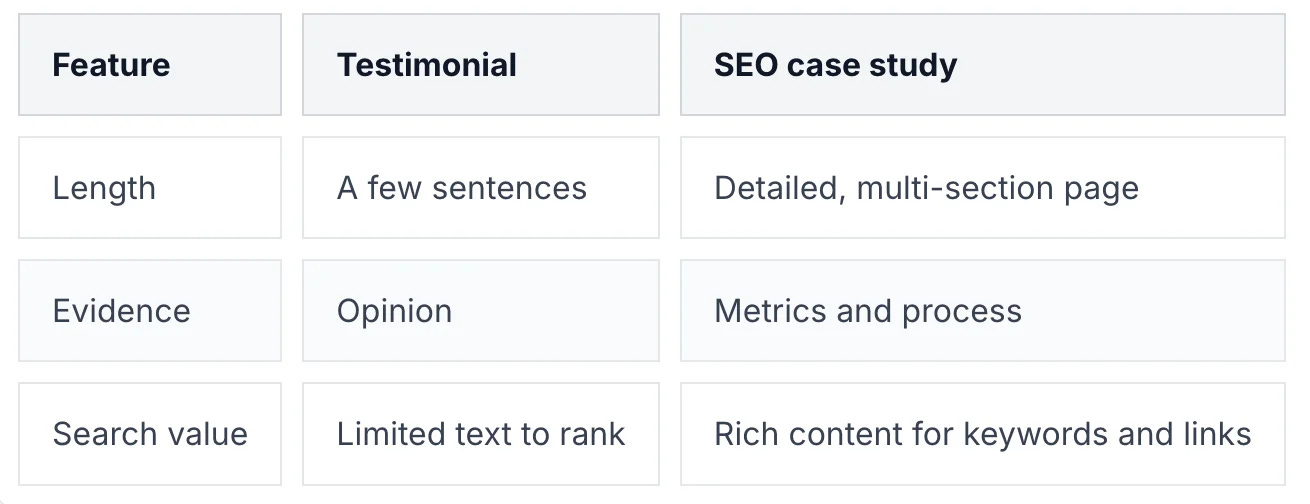
That depth is what makes a case study useful for both readers and rankings.
How Case Studies Improve Rankings and Organic Traffic
Targeting long-tail and industry keywords
A case study naturally covers specific topics, industries, and problems. That makes it a strong fit for long-tail searches.
Think of a page about a medical group or a travel brand, such as the Visit Atlantic City example. It can rank for niche phrases that a general service page never reaches.
Industry terms appear in context, not stuffed in.
Problem-focused phrases match what searchers type.
Detailed results give search engines more to understand and index.
More relevant pages mean more entry points for organic traffic.
Earning backlinks and shares
Original results are worth citing. Other writers reference them, and each mention can become a backlink.
Case studies also travel well on social media and in newsletters. Wider reach brings more visitors, and more links signal authority to search engines.
The payoff builds over time. One well-made page can keep attracting links and website traffic long after it is published.
Building Trust and Authority With Search Visitors
Demonstrating E-E-A-T through real results
Google looks for experience, expertise, authoritativeness, and trustworthiness. A case study shows all four in one place.
You are not claiming skill. You are proving it with a named client, a clear process, and measurable outcomes.
Experience: you did the work and can describe it.
Expertise: your strategy explains why each step mattered.
Authoritativeness: outside sites cite your results.
Trust: specific details are harder to fake than general claims.
Turning readers into leads
Visitors who find a case study through search are often comparing providers. They want evidence before they make contact.
A page that matches their problem answers the question they came with.
Open with the challenge the reader likely shares.
Place the key result near the top.
Keep the format consistent so prospects scan quickly.
That is how organic traffic moves from curiosity to genuine interest in your services.
Learning What Works From Real Examples
Lessons from Google and industry case studies
Industry studies add detail on tactics and outcomes:
Meta refocused its SEO strategy and doubled monthly traffic with the help of BrightEdge.
One step-by-step study reports a 700% organic traffic increase in 12 months.
Several B2B SaaS studies report up to 43x more pipeline, leads, and signups.
Read each one for the pattern behind the number: what changed, in what order, and why.
Local service example: Russo Electrical
Russo Electrical, an electrician in Sydney, keeps a dedicated case studies page. It is a useful model for any local trade or service company.
Each project page can describe the job, the problem the customer had, and how it was solved. That gives searchers real examples of the work.
For instance, it covers projects on: Freestanding Electric Cooker Replacement in Drummoyne, Meter Box and Switchboard Upgrade in Five Dock, and LED Oyster Light Replacement in Gladesville.
Local and service terms appear naturally in the text.
Past jobs act as proof for new customers.
Every project adds another page that can rank.
Small businesses can copy this approach without a large budget.
How to Write a Case Study That Ranks
Using metrics, charts and before-and-after comparisons
Numbers make a case study credible. Start with the problem, then show what changed.
Use only results you can verify. Name the metric, the time frame, and the starting point.
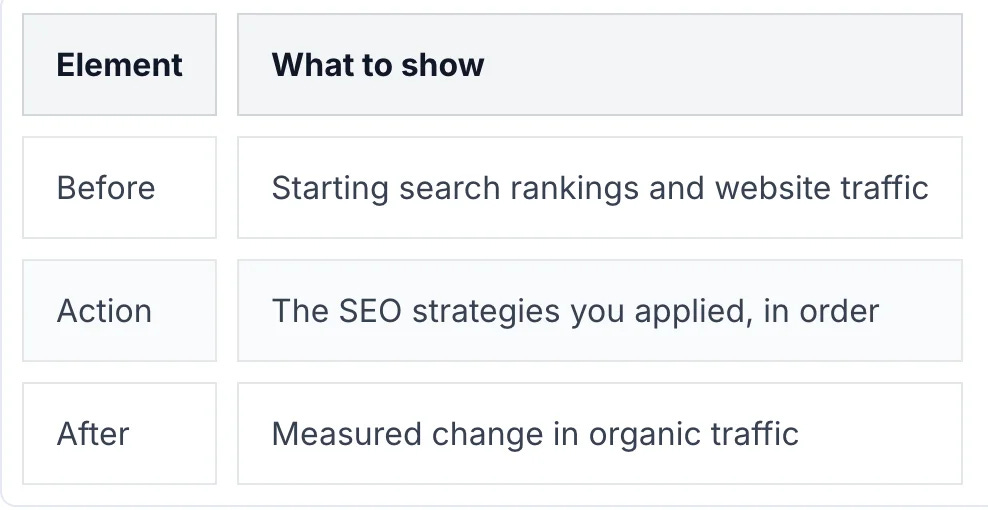
Charts help readers grasp the shift at a glance. Add short alt text so search engines understand each image.
On-page optimization and internal linking
Treat the page like any other you want to rank. Choose one main keyword and place it where it counts.
Put the keyword in the title, a heading, and the opening lines.
Write a clear meta description that previews the result.
Use descriptive headings for each stage of the project.
Link to related service pages and other case studies.
Internal links pass authority to your key pages. They also guide visitors from proof to the service they need.
Measuring the SEO Impact of Your Case Studies
Traffic, rankings and conversions to track
Publishing is only half the job. You need to see whether each page earns its place in your marketing strategy.
Set a baseline before launch, then check the same figures at regular intervals.
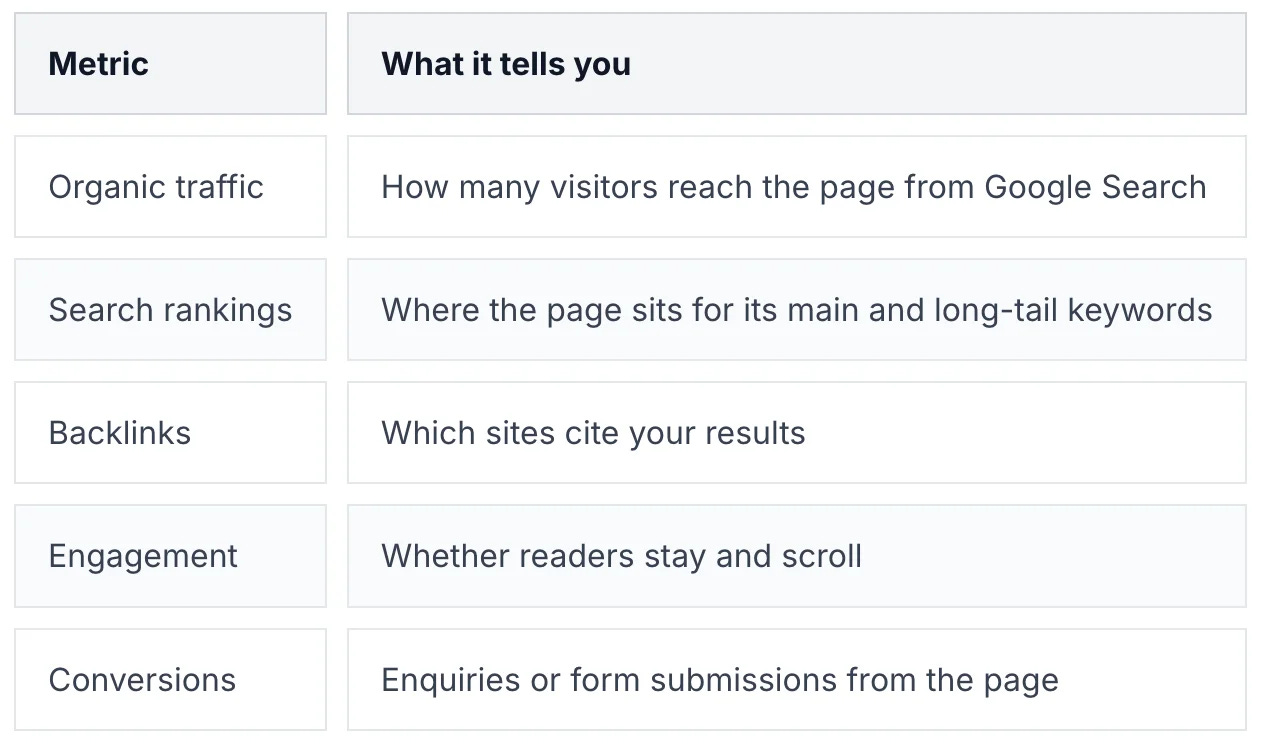
Google Search Console shows impressions, clicks, and the queries that bring people to each case study.
Compare the page against your other content. If it brings fewer visits but more enquiries, it is still doing its job.
Review results every quarter. Update the page when new data comes in, and refine the title or headings if rankings stall.
FAQ
What are the benefits of case studies for SEO?
They give you pages built around real results. That supports search rankings, earns backlinks, and builds trust with visitors who arrive from Google Search.
Can you provide some examples of SEO case studies?
Google Search publishes its own SEO success stories. Russo Electrical shows how a local service business can present past jobs.
Do case studies help small businesses?
Yes. A local company can turn finished jobs into pages that carry service and location terms. Each page adds another chance to appear in search.
How long should an SEO case study be?
Length matters less than clarity. Cover the background, goals, strategy, and results, and keep the format consistent.
How is a case study different from a testimonial?
A testimonial is a short opinion. A case study explains the problem, the actions taken, and the measured outcome.
How often should you update a case study?
Review it every quarter, and add new data when results change.
Which metrics prove a case study works?
Organic traffic to the page
Rankings for main and long-tail keywords
Backlinks from other sites
Enquiries or form submissions
Track all four against a baseline set before launch.
Turning Real Results Into Lasting Search Visibility
Case studies give your SEO strategy something most pages lack: evidence. They show search engines a focused, topical page and show visitors a result they can check.
That combination works in three ways:
It widens your reach for long-tail and industry searches.
It earns citations from other website owners.
It moves readers closer to an enquiry.
Start small. Pick one finished project, gather the before and after figures, and publish a clear page built around a single keyword.
Then repeat. Over time, a library of real-life examples becomes a durable part of your online presence and a steady source of organic traffic.